

Join Us to Unlock the Intelligence Layer for Your Business atCommunity Summit North America
Booth #1919
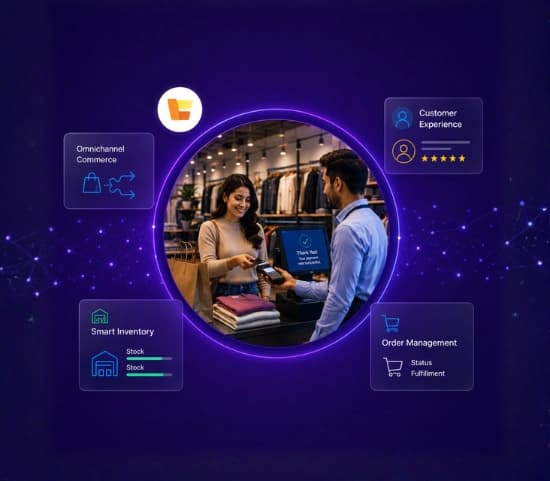
Customers today move between your website, physical stores, mobile app, and call center as a single continuous journey. They expect to browse online, try in-store, order via mobile, and pick up curbside without repeating themselves or encountering inconsistent pricing, stock information, or promotions.
Most retailers are not keeping up and still operate with disconnected systems. Research shows that only 5% of retailers have achieved true unified commerce.
The consequences of running disconnected systems are measurable. Retailers with fragmented commerce architectures face higher cart abandonment rates, excess fulfillment costs, and inconsistent customer experiences that erode loyalty. Omnichannel customers spend more per order and deliver higher lifetime value than single-channel buyers but capturing that value requires a platform that unifies data, operations, and customer interactions across every touchpoint.
Microsoft Dynamics 365 Commerce is a headless, omnichannel retail and B2B solution that unifies in-store point of sale (POS), digital e-commerce, call center operations, and back-office management on a single cloud-native platform.
Unlike standalone e-commerce tools or bolt-on POS systems, D365 Commerce is natively integrated with Dynamics 365 Finance and Supply Chain Management. This means your commerce operations share the same data layer as your financial management, inventory planning, and supply chain execution, eliminating the data silos, manual reconciliation, and integration fragility that plague multi-vendor architectures.
It has a composable, API-first architecture that gives you the flexibility to power custom storefronts, third-party marketplaces, or emerging channels without rebuilding your core commerce logic.
Built on Microsoft Azure, D365 Commerce delivers enterprise-grade security, global compliance coverage, and the scalability to support multi-country, multi-currency retail operations from day one.
The core capabilities of Dynamics 365 Commerce cover areas that together build a complete omnichannel retail operation: in-store POS, digital commerce, intelligent order fulfillment, pricing and promotions, customer engagement, and assisted selling. Each capability is natively connected to D365 Finance and Supply Chain Management, ensuring a single source of truth across channels.
Beyond the core capability areas, Dynamics 365 Commerce includes a set of platform-level features that underpin the entire solution. These features represent the functional building blocks available across all channels:
Cross-platform POS (Windows, iOS, Android) with fixed, mobile, and self-checkout modes. Online and offline operation with React/Fluent 2 UI.
API-driven Commerce Scale Unit exposing all commerce logic. Power any frontend, marketplace, or conversational channel from a single engine.
Rule-based order orchestration using MIP and predictive models. Optimizes fulfillment across stores, warehouses, and third-party nodes.
AI-assisted product and marketing content authoring. Copilot drafts descriptions, enriches catalog data, and accelerates site development.
Customers order from any warehouse or store stock, ship to address or pick up locally. Associates access full catalog beyond on-shelf inventory.
Self-service distributor portals with headless APIs. Contract pricing, multi-outlet ordering, credit management, and bulk workflows.
Real-time cross-channel inventory visibility globally. Accurate availability promises across POS, e-commerce, and call center.
Customizable loyalty schemes with points conversion. AI-powered recommendations based on browsing, purchase patterns, and segments.
Intelligent, contextual product search powered by Azure AI Search across online and in-store channels.
Commerce authoring tools with Accessibility Insights integration for accessible page content.
Each feature is natively integrated with the broader Dynamics 365 platform, meaning data flows bidirectionally between Commerce, Finance, Supply Chain Management, and Customer Insights without custom middleware or third-party connectors.
Dynamics 365 Commerce embeds AI across the entire retail value chain at two levels. Copilot provides human-assisted AI that boosts merchandiser, associate, and site builder productivity within existing workflows. The Commerce MCP Server enables a new class of autonomous AI agents that sense, decide, and act across discovery, checkout, fulfillment, and store operations with configurable automation and human-in-the-loop approval workflows.
Beyond real-time assistance, agents operate with configurable automation and approval workflows. They detect restocking needs from demand signals and trigger reorder actions. Pricing agents read trade agreements and margin targets to adjust prices across channels. Inventory agents reposition stock based on predicted demand.
When Commerce and ERP MCP Servers work together, agents access the full value chain from planning to selling to settlement.
Alletec implements and configures these AI and agentic capabilities as part of every Commerce engagement, ensuring your organization captures value from Microsoft's AI investments from day one.
Retailers evaluating commerce platforms typically compare D365 Commerce against standalone e-commerce tools like Shopify Plus or BigCommerce Enterprise, full-stack competitors like SAP Commerce Cloud or Salesforce Commerce Cloud, and legacy POS systems like Oracle Retail.
Here is where D365 Commerce differentiates:
D365 Commerce shares the same Dynamics 365 data layer as Finance, Supply Chain Management, and Human Resources. Inventory, pricing, customer data, and financial transactions flow bidirectionally without custom integrations or middleware.
The Commerce Scale Unit exposes all business logic through composable APIs, enabling any customer-facing experience (web, mobile, marketplace, conversational, IoT) from a single engine with full frontend freedom.
D365 Commerce supports D2C, B2B, and B2B-for-wholesalers from a single platform with channel-specific pricing, catalogs, and customer experiences. No separate instances required.
No other commerce platform offers a first-party MCP server enabling conversational commerce across ChatGPT, Copilot Studio, and messaging channels. AI is embedded, not bolted on.
D365 Commerce was built for physical and digital retail at enterprise scale, with offline-capable POS, clienteling, self-checkout, and store operations as core functionality, not e-commerce afterthoughts.
For organizations already invested in the Microsoft ecosystem, or those that need a single platform covering both physical store operations and digital commerce with native ERP integration, Dynamics 365 Commerce is the strongest fit. Standalone platforms like Shopify Plus suit e-commerce-only businesses, but cannot match the depth of integrated retail operations, B2B capabilities, and AI-native architecture that D365 Commerce delivers.
Dynamics 365 Commerce is not a standalone product. It is designed to operate as one application within the broader Microsoft business application stack, sharing data, security, AI services, and integration infrastructure with every other Dynamics 365 module. This native connectivity eliminates the middleware, custom connectors, and data synchronization overhead that retailers face when stitching together multi-vendor commerce architectures.
For organizations already running Dynamics 365 Finance and Supply Chain Management, adding Commerce is a natural expansion that leverages your existing investment, data, integrations, and team knowledge.
Dynamics 365 Commerce serves a range of businesses across retail, direct-to-consumer, B2B, and manufacturing sectors. The platform is designed for mid-market and enterprise organizations that operate across physical and digital channels and need unified commerce operations on a single platform. The following scenarios represent the most common use cases:
Brick-and-mortar stores that are looking to launch e-commerce without creating a second, disconnected tech stack. D365 Commerce extends your existing ERP to digital channels, sharing inventory, pricing, and customer data across both.
Businesses that sell directly to consumers and need more than a marketplace listing. D365 Commerce provides a fully owned digital storefront with integrated order management, personalization, and fulfillment orchestration.
Manufacturers that need to provide distributors and wholesale buyers with self-service portals for inventory review, order placement, and fulfillment tracking via headless commerce APIs with contract pricing and multi-outlet ordering.
Wholesale and B2B businesses that want to provide their buyers with self-service portals, real-time inventory, contract pricing, and multi-outlet ordering. D365 Commerce delivers this within the same platform that runs your ERP.
Businesses that already use Dynamics 365 Finance and Supply Chain Management for their core operations can adding D365 Commerce to extend their existing platform to retail channels without introducing a separate vendor, integration layer, or data silo.
Retail businesses that operate across countries with different tax regimes, payment methods, currencies, and languages. D365 Commerce supports multi-country, multi-currency, and multi-language operations natively, with localized compliance built into the platform.
The cost of disconnected commerce compounds every quarter from duplicate licensing and middleware maintenance to manual reconciliation and inventory blind spots across channels. Unified commerce on Dynamics 365 reverses these compounding costs into compounding returns by consolidating operations, data, and customer engagement on a single platform. Here are the key business outcomes that D365 Commerce drives:
Omnichannel customers spend more per order and deliver higher lifetime value compared to single-channel buyers. Retailers with mature, unified commerce capabilities report lower cart abandonment rates because pricing, promotions, and inventory are consistent across channels.
Distributed Order Management calculates proximity, inventory depth, and partial-order rules to reduce the number of shipment splits per order. This minimizes shipping costs and maximizes inventory utilization.
Companies with strong omnichannel strategies deliver consistent experiences that meet customer expectations. This drives higher customer retention rate compared to those with weak cross-channel programs.
A single platform for POS, e-commerce, call center, and back-office operations eliminates the cost and complexity of maintaining separate systems, middleware, and manual reconciliation processes.
The composable, API-first architecture and React-based Site Builder allow you to launch new storefronts, enter new markets, and respond to seasonal demand faster than custom-built alternatives.
Choosing the right implementation partner is as important as choosing the right platform. A Dynamics 365 Commerce deployment touches POS hardware, e-commerce frontend development, payment gateway integration, order management configuration, and ERP data flows. Alletec brings the Microsoft credentials, retail domain expertise, and implementation methodology to deliver Commerce projects end-to-end.
Recognized amongst the 1% of Microsoft's global partner ecosystem for sustained delivery excellence, platform expertise, and customer impact.

Microsoft validated credential across all the Microsoft solution areas (Business Application, Data & AI, Azure Infrastructure, Digital & App Innovation, Modern Work, and Security) — demonstrating full-stack Microsoft capability.

Alletec holds Microsoft FastTrack Recognized status, qualifying us to guide enterprise-scale Dynamics 365 deployments through Microsoft's structured FastTrack methodology for accelerated, lower-risk go-lives.

A Microsoft-focused organization with 25+ years of delivery experience across Dynamics 365 and the extended Microsoft stack.
A team of domain experts with deep know-how of retail workflows, best practices, and reusable industry templates for accelerated, low-risk delivery.
With offices in the USA, Canada, Kenya, India, and the UAE, we are able to deliver projects globally covering multi-country rollouts with localization, multi-language configuration, and region-specific compliance built into every deployment.

Full-cycle implementation services from discovery to post-go-live support. Alletec covers every phase from licensing advisory through continuous improvement.

Every implementation is architected to activate Copilot, configure autonomous sales agents, and connect custom data sources through Copilot Studio from the start.
Whether you are evaluating unified commerce for the first time, planning to extend your existing Dynamics 365 ERP to retail and e-commerce, or replacing a legacy POS and e-commerce stack, the right first step is a conversation with a partner who understands the platform at depth.
Through a discovery call, Alletec Retail & Commerce experts will assess your current architecture, identify the highest-impact use cases, and map a realistic path to go-live covering scope, timeline, and investment needed for your business.
Dynamics 365 Commerce is Microsoft's headless, omnichannel retail and B2B solution. It unifies point of sale (POS), digital e-commerce (D2C, B2B, and wholesale), call center operations, order management, merchandising, and back-office operations on a single cloud-native platform natively integrated with Dynamics 365 Finance and Supply Chain Management.